
Sourcing in 2025/2026 demands more than running events or following standard playbooks.
This requires a sourcing strategy built for today’s realities, not yesterday’s assumptions.
Supplier markets are shifting faster.
Internal expectations are higher.
Budgets are tighter.
Risk is more unpredictable.
Technology is changing procurement’s role entirely.
A modern sourcing strategy in 2025/2026 needs to reflect all of that – not the traditional “7 steps” from procurement textbooks.
Here’s what leading teams are doing now, and how you can build a sourcing strategy that actually works in today’s environment.
1. Start With the Business Outcome, Not the Spend Category
Traditional sourcing starts with:
“Here’s the category. Let’s source it.”
Modern sourcing starts with:
“What business outcome are we solving?”
Examples:
- Reduce downtime caused by supplier failures
- Improve lead-time reliability for product launches
- Consolidate fragmented suppliers to increase leverage
- Meet sustainability or ESG requirements
- Reduce risk in high-dependency categories
When procurement starts with outcomes, the sourcing cycle becomes clearer and more aligned with stakeholders.
2. Build Your Strategy Around Supply Market Intelligence
Stakeholders often default to “the supplier we’ve always used.” In 2025/2026, that’s no longer enough.
Modern sourcing requires:
- Understanding price trends
- Tracking new entrants
- Watching supplier capacity fluctuations
- Monitoring M&A activity
- Identifying regional/geopolitical exposure
- Evaluating sustainability maturity
Market intelligence prevents backward-looking strategies and expands your supplier universe.
3. Strengthen Pre-RFP Supplier Qualification
This is where most sourcing processes silently fail: the wrong suppliers make the shortlist.
A strong sourcing strategy includes a repeatable pre-RFP assessment:
- Financial stability
- Capability and capacity alignment
- Quality certifications
- ESG and compliance requirements
- Delivery performance (historical)
- Geographic and operational fit
When qualification is weak, even a strong RFX produces weak outcomes.
4. Match the Sourcing Approach to the Complexity
Modern sourcing strategies tailor the method to the situation:
- Simple, transactional items: quick RFQs or eAuctions
- Strategic partnerships: weighted scoring + capability assessment
- Innovation-led categories: collaborative workshops, qualitative scoring
- High-risk categories: multi-round vetting, deep risk scoring
- Services sourcing: KPI frameworks + capacity and fit evaluation
Not every category needs a full-blown RFP.
Not every RFP needs weeks of evaluation.
5. Use Scenarios to Guide Awards, Not Just Price Comparisons
Award decisions used to be linear:
- Lowest bid
- Or best value
- Followed by manual negotiation
2025/2026 sourcing is scenario-driven:
- Volume splits
- Cost-risk tradeoffs
- Capacity constraints
- Lead-time impact
- Supplier diversification needs
- Compliance risk
- Switching cost
Scenario modeling helps leaders walk into stakeholder discussions with clarity, evidence, and confidence.
6. Build Relationship Plans Into the Strategy
Sourcing doesn’t end at the award. Your sourcing strategy should include a simple but structured plan for the next 12 months:
- The KPIs suppliers will be measured against
- Expected improvements
- Communication cadence
- Performance review structure
- Data that both sides will share
- Risks to monitor throughout the year
The sourcing event is the start of the relationship, not the conclusion.
7. Integrate Technology, But Don’t Let It Dictate the Strategy
A mature sourcing strategy avoids two traps:
- Designing processes around tool limitations
- Or ignoring tools and doing everything manually
The right balance is:
Define the strategy → then use technology to make it scalable and repeatable.
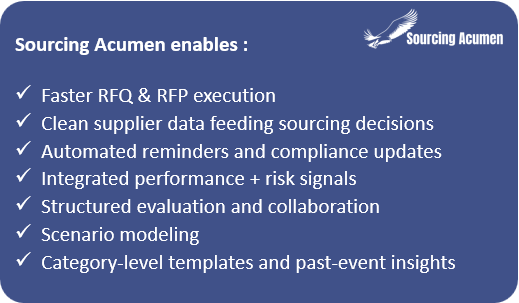
Where Sourcing Acumen fits organically:
- Faster RFQ & RFP execution
- Clean supplier data feeding sourcing decisions
- Automated reminders and compliance updates
- Integrated performance + risk signals
- Structured evaluation and collaboration
- Scenario modeling
- Supplier self-service
- Category-level templates and past-event insights
The technology amplifies the strategy, it doesn’t replace it.
Conclusion: A Modern Sourcing Strategy Creates Speed, Confidence, and Better Decisions
A sourcing strategy for 2025/2026 isn’t a step-by-step checklist. It’s a way of operating.
The strongest strategies are:
- Outcome-driven
- Intelligence-led
- Qualification-focused
- Scenario-based
- Relationship-oriented
- Technology-enabled
Procurement teams that adopt this approach move faster, make clearer decisions, and reduce risk more effectively.
That’s exactly the operating model Sourcing Acumen was built to support – connecting sourcing, supplier data, risk, performance, and collaboration into one unified experience.
When sourcing strategy and technology align, procurement moves from running events → to driving the business.