Over the past decade, procurement technology has matured significantly across organizations.
- Procure-to-Pay systems standardize purchasing workflows
- Sourcing platforms strengthened competition and analytics
- Contracts and supplier data moved into digital systems
Yet many organizations still struggle to influence spending early enough to create meaningful value.
The challenge is no longer system capability – it is when procurement becomes involved.
In many organizations, procurement operations rely heavily on ERP-based purchasing workflows (such as Dynamics 365, Oracle, Epicor, or SAP). These systems effectively control transactional processes such as purchase orders, approvals, and financial records. However, ERP requisition processes typically rely on business users to select suppliers, define scope, and determine purchasing paths – often without visibility into preferred suppliers, negotiated contracts, or sourcing strategies.
By the time procurement becomes involved, the request has already taken the form of a transaction rather than a business need. Suppliers may have been contacted, pricing discussed, and internal decisions informally aligned.
Procurement executes – it does not shape.
Over time, this leads to value leakage. Organizations continue buying from incumbent suppliers without testing market competitiveness, urgent purchases bypass sourcing discipline, and similar items are purchased at different prices across the business.
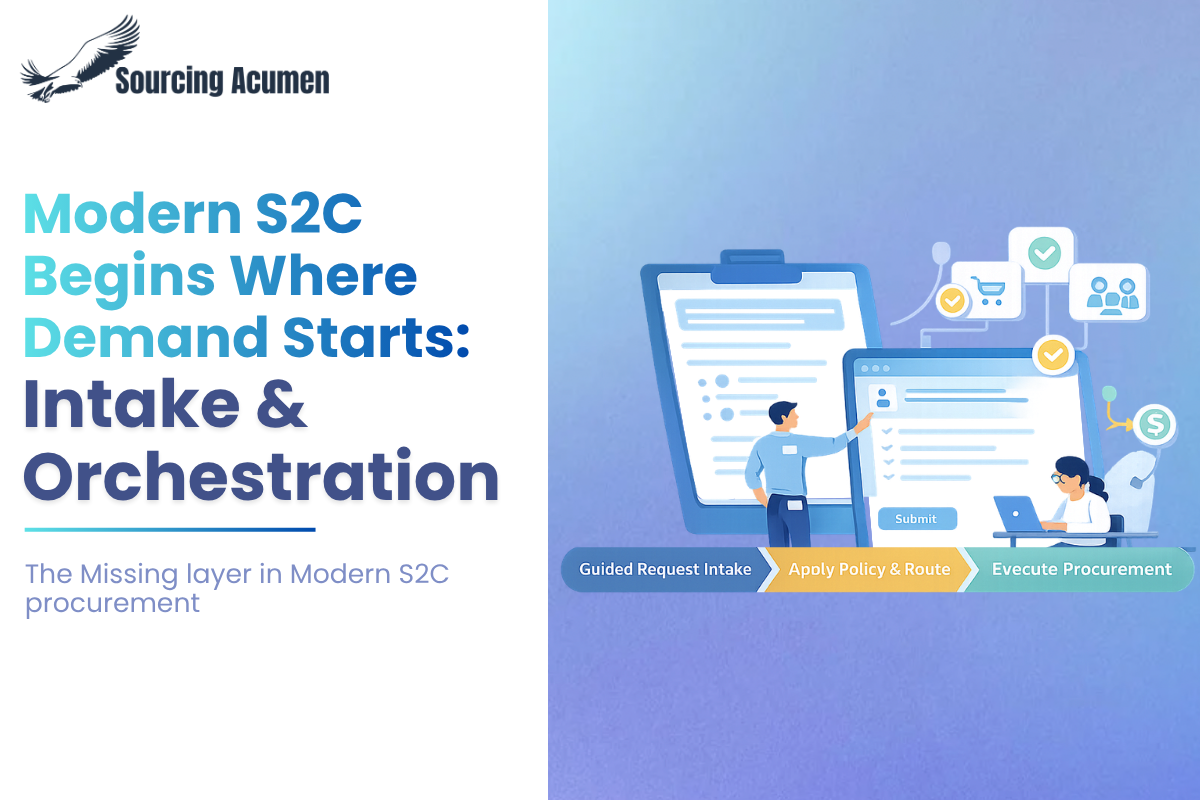
Modern Source-to-Contract (S2C) platforms address this challenge by introducing structure at the moment demand originates.
Instead of beginning with a transaction, procurement processes begin with the business need. Guided intake captures requests early, applies purchasing policies automatically, and routes demand through the appropriate sourcing or purchasing pathway.
Procurement gains earlier visibility into demand. High-value or high-risk purchases receive appropriate sourcing rigor, while routine purchases move efficiently through defined policies. Bottlenecks and risks become visible earlier, enabling corrective action before commitments are made.
At the same time, the purchasing experience becomes easier for business users. Requests, approvals, and purchasing workflows become accessible and intuitive, allowing demand to enter the system quickly while still maintaining governance.
The result is a procurement operating model where demand is captured earlier, purchasing decisions become more structured, and procurement teams can focus their effort where it creates the greatest value.
Procurement moves from reviewing transactions to guiding decisions at the source of demand.
- What Intake & Orchestration Does in a Modern S2C Platform
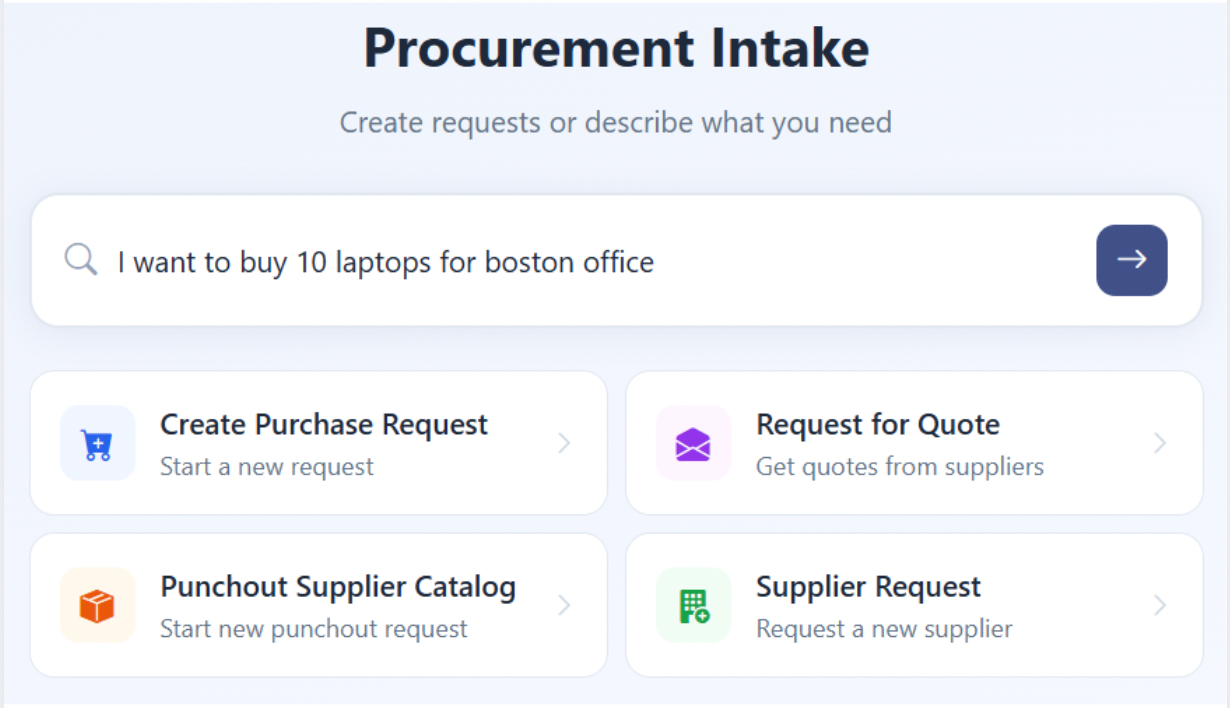
Intake and orchestration capture business demand and automatically route it through the appropriate procurement processes.
It functions as a single front door for procurement, where employees express what they need while the platform determines the correct purchasing pathway.
Instead of requiring business users to understand procurement procedures, the system interprets the request and applies the appropriate policies and actions automatically.
Depending on the request, this may involve:
- Purchasing through an approved catalog
- Using a preferred supplier
- Initiating a competitive sourcing process
- Onboarding a new supplier
- Enabling an automated low-risk purchase
Example Scenarios
- Operations require motors and pumps → Punchout purchase through Grainger
- Marketing requires branded giveaways → Catalog purchase through approved rate cards
- Operations requires projectors for training → Free-form request triggering automated three-bid sourcing with preferred suppliers
In Sourcing Acumen, Intake and Orchestration ensure that requests enter procurement complete, accurate, and policy-aligned, reducing manual buyer intervention and eliminating corrective rework.
- How Modern Intake & Orchestration Works
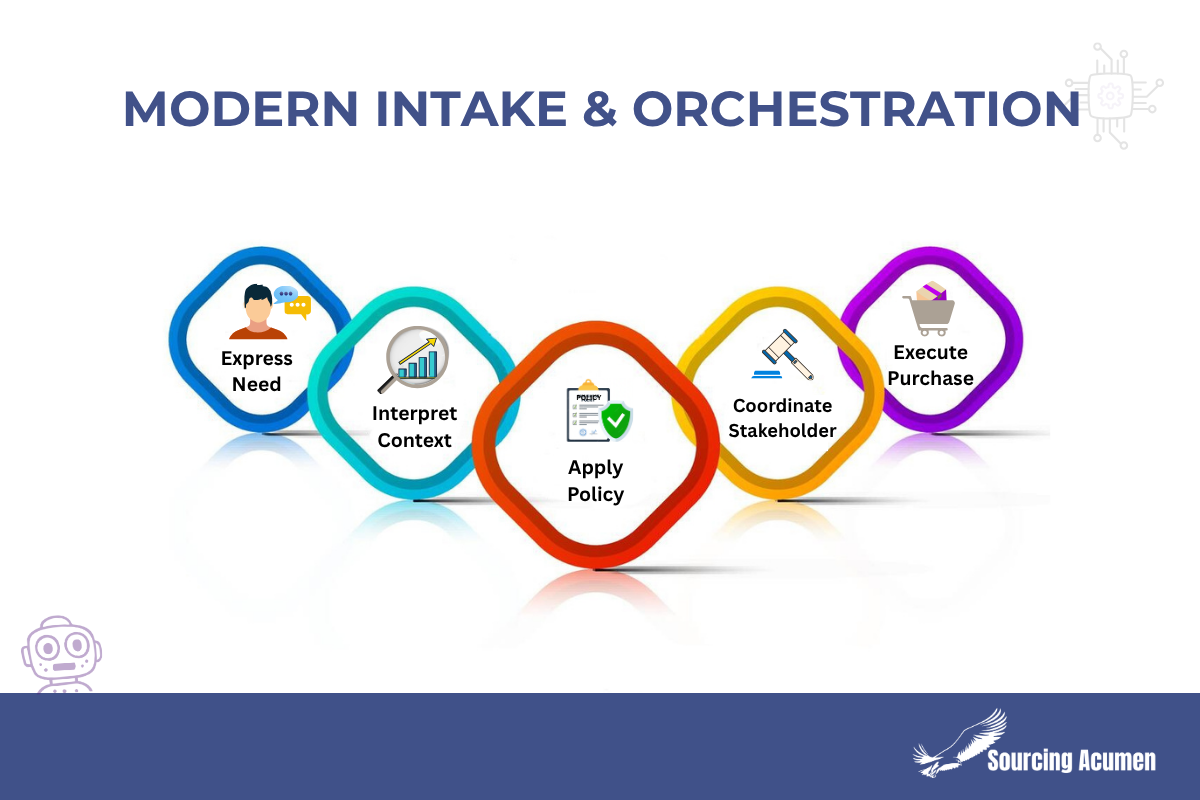
Modern intake converts a business request into governed procurement execution through a structured flow.
A typical request progresses through five stages.
Step 1: Express the Need
A business user submits a request through a guided interface. The system captures the required information and surfaces relevant catalogs, preferred suppliers, or existing contracts in real time.
Step 2: Interpret Context
The platform evaluates attributes such as category, spend level, supplier status, and risk indicators to understand the nature of the request.
Step 3: Apply Policy
Approval requirements, sourcing involvement, and compliance checks are applied automatically. Low-risk purchases may proceed autonomously, while higher-value requests trigger appropriate oversight. Approvals can happen “on the go,” removing delays associated with traditional approval workflows.
Step 4: Coordinate Stakeholders
Finance, legal, IT, and procurement teams are engaged where necessary. Reviews can occur in parallel, maintaining speed while preserving governance. Escalations occur automatically when approvals become bottlenecks.
Step 5: Execute Seamlessly
Requests transition directly into sourcing events, supplier workflows, contract processes, or purchase order generation. Information captured during intake carries forward automatically, eliminating duplicate data entry.
The Result
- Procurement focuses on strategic sourcing and negotiations
- High volumes of low-value requests can move through automated pathways
- Governance remains embedded and auditable
- Standardization, better utilization of preferred suppliers & catalogs
- Modern S2C Platforms Vs ERP Systems
ERP systems effectively control transactional processes such as purchase orders, approvals, and financial records.
However, ERP procurement capabilities are primarily designed for transaction execution, not for shaping purchasing decisions.
When a requisition is created inside the ERP, the requester is typically expected to fill out a form and:
- Select a supplier
- Define item codes or scope
- Determine the purchasing pathway
- Submit the request for approval
At this point, the purchasing decision has largely been formed.
Modern Source-to-Contract (S2C) platforms introduce an upstream decision layer that operates before the transaction begins.
Through guided intake, the platform captures the business need and determines the correct procurement pathway automatically, whether that involves:
- Purchasing through an approved catalog
- Initiating competitive sourcing
- Using a preferred supplier
- Onboarding a new supplier
- Enabling automated purchasing
Once the purchasing decision is defined, the process moves into execution.
Purchase orders may be generated within the procurement platform, while financial transactions such as invoicing and accounting continue to be processed within the ERP.
The lifecycle, therefore, becomes:
Business Need → Guided Intake → Policy & Sourcing Decision → PO Creation → ERP Financial & Payment Processing
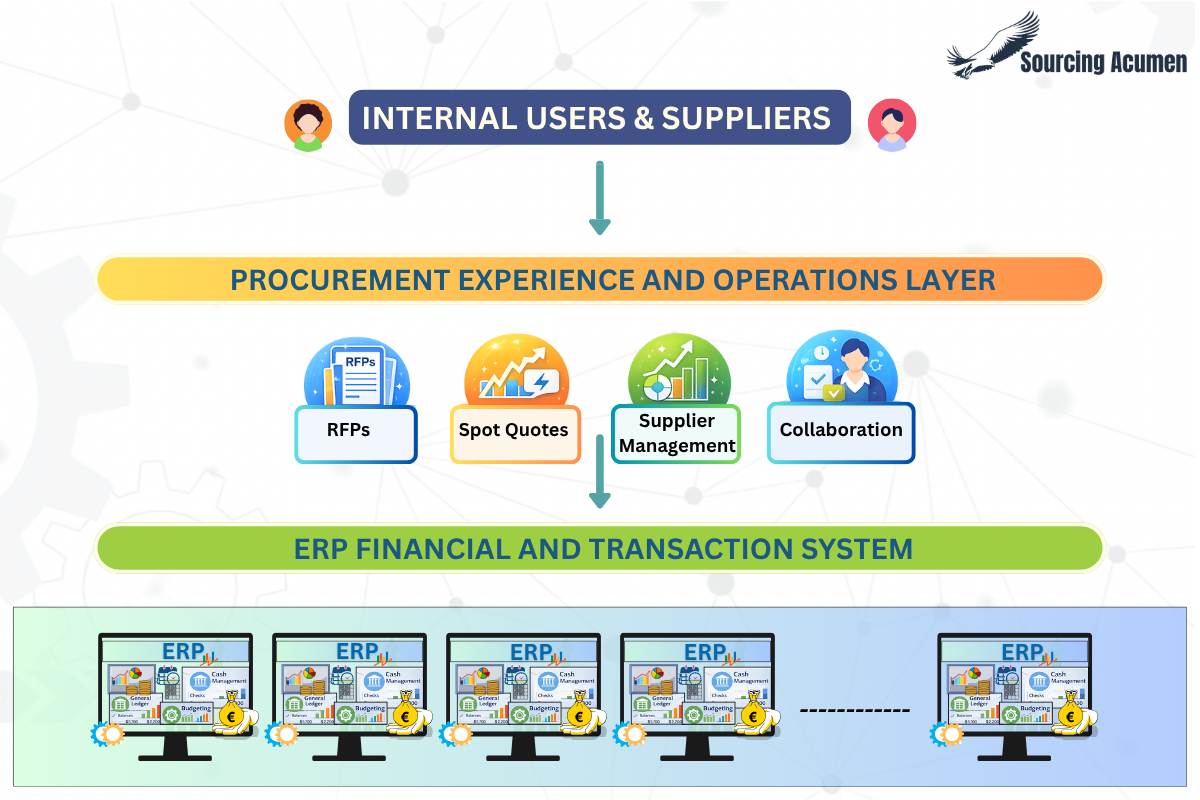
This architecture allows organizations to combine the financial governance of ERP systems with the strategic decision-making capabilities of modern procurement platforms.
- Business ROI: How Modern S2C Improves Procurement Outcomes
Introducing structure at the moment, demand is created, which produces meaningful operational and financial benefits.
Demand Consolidation Toward Preferred Suppliers
Approved suppliers, contracts, and catalogs are surfaced automatically during request creation. As a result, more purchases flow through preferred suppliers and negotiated agreements.
Higher Utilization of Catalogs and Negotiated Pricing
When approved catalogs appear during purchasing requests, buying behavior naturally shifts toward standardized SKUs and negotiated pricing, reducing price variation across similar purchases.
Structured Competitive Sourcing
Competitive sourcing processes such as three-bid workflows can be triggered automatically when required, ensuring sourcing discipline without manual coordination.
Consistent Approvals and Compliance
Approval rules remain embedded in every request. High-value or high-risk purchases receive appropriate oversight while routine transactions move efficiently according to policy.
Greater Visibility Into Demand and Risk
Procurement teams gain real-time insight into where spend is occurring, allowing buyers to focus on high-value opportunities and potential risks.
More Strategic Use of Buyer Capacity
Routine purchasing activity becomes structured and easier to process, allowing procurement professionals to focus on supplier negotiations, cost optimization, and strategic sourcing initiatives.
- How the User Experience Changes and Why Adoption Improves
One of the largest barriers to procurement effectiveness is not policy; it is adoption.
When purchasing requires complex ERP navigation, spreadsheet-driven sourcing, and manual coordination, adoption declines and procurement engagement often occurs too late.
Modern intake and orchestration simplifies how employees request purchases while ensuring governance and supplier strategy are applied automatically.
The difference is best illustrated by how purchasing operates before and after guided intake.
From Fragmented Purchasing to Guided Procurement
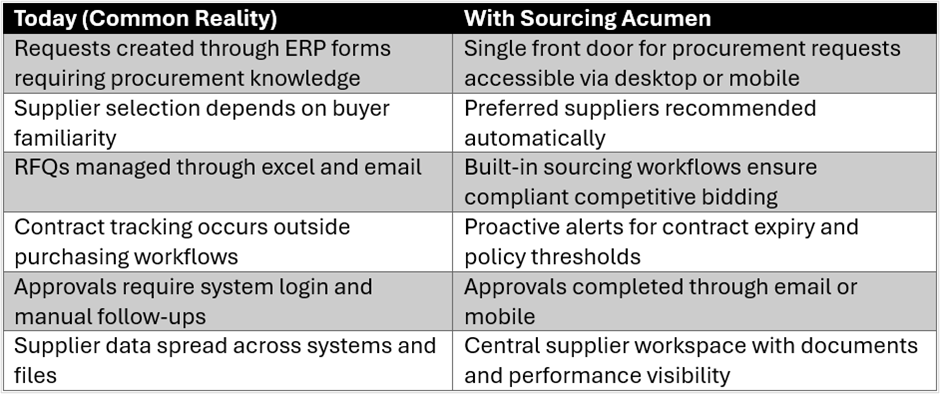
The Result
When purchasing becomes easier for the business to use, adoption improves naturally.
Employees can create requests quickly, approvals move faster, and procurement gains earlier visibility into demand. At the same time, supplier recommendations, sourcing workflows, and approval controls ensure purchasing remains compliant and strategically aligned.
The result is a procurement experience that is simpler for employees while giving procurement stronger oversight and influence.
Final Thought
Organizations that modernize how demand enters procurement do more than improve purchasing workflows. They enable procurement to influence decisions earlier, consolidate supplier spend more effectively, and apply sourcing discipline across the organization.
Intake and orchestration are, therefore, not simply a workflow improvement. It is the missing layer that connects business demand with procurement strategy – allowing procurement technology to deliver its full strategic value.
Sourcing Acumen – where procurement starts shaping decisions, not just processing them.