Guided buying has become a critical capability for modern procurement teams, but it is often misunderstood. In many organizations, it is treated as a control mechanism rather than an operating model. The result is predictable: slower purchasing cycles, frustrated stakeholders, and governance that feels heavy instead of helpful.
When designed correctly, guided buying does something very different. It enables faster decisions, clearer accountability, and greater trust across requesters, procurement, and leadership. This article explores why guided buying often fails and how organizations can design it to deliver both speed and confidence at scale.
A requester submits what looks like a simple request.
Procurement still gets pulled in.
An approver hesitates.
No one feels fully confident that the outcome was quite right.
This pattern repeats daily – not because policies are unclear or people are careless, but because most procurement processes fail to separate routine purchases from decisions that require judgment.
Many organizations try to fix this with more controls: additional approvals, tighter thresholds, heavier documentation. The result is predictable. Routine work absorbs disproportionate attention, while genuinely sensitive decisions still rely on individual discretion.
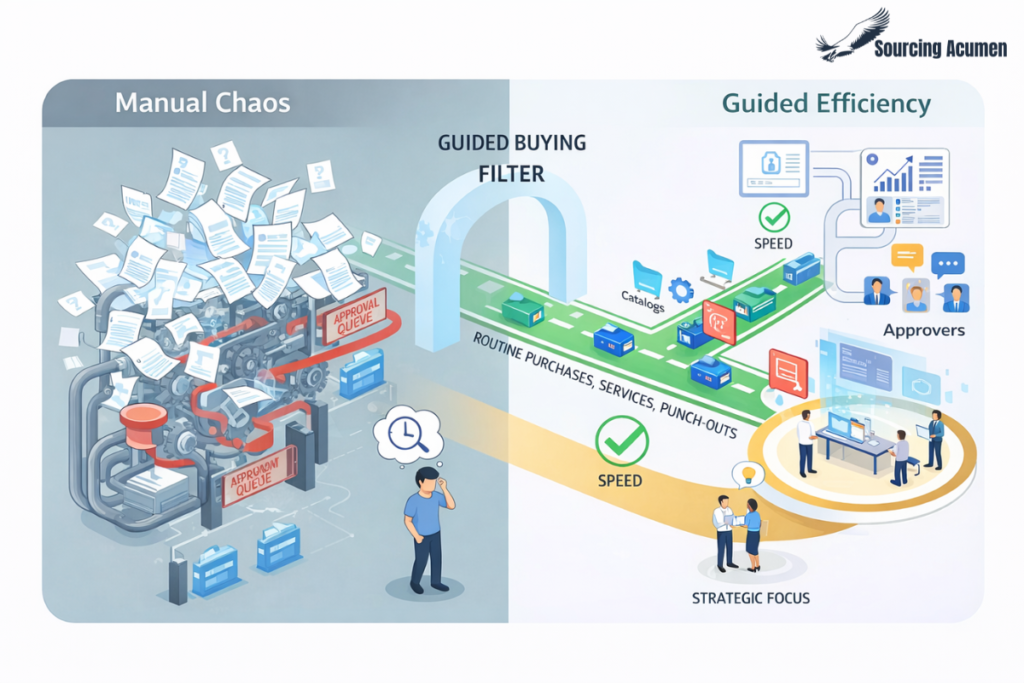
Guided buying works when it fixes this mismatch at the source. By shaping requests early – before buyers or approvers engage – it allows routine purchases to move predictably, while making true exceptions visible and deliberate. When that balance holds, speed becomes sustainable and trust compounds across requesters, procurement, and leadership.
I. The Current Operating Reality
Most procurement teams don’t struggle due to lack policy.
They struggle because everything that enters the process looks the same.
A low-risk purchase and a judgment-heavy decision often arrive through identical intake paths, with similar information quality and similar expectations for review. Buyers are forced to interpret intent after the fact. Approvers are asked to apply judgment without enough context.
As a result, procurement spends significant time on work that is neither strategic nor value-adding: clarifying scope, reconstructing rationale, and translating incomplete requests into something approvable.
It’s an operating model problem vs discipline problem
II. Why Traditional Controls Stop Working
Most organizations respond to this friction by tightening governance.
They add approval layers.
They raise documentation requirements.
They introduce stricter thresholds.
These measures feel responsible, but they rarely improve decision quality. Instead, they flatten the process. Routine work slows down, while high-judgment decisions still depend on individual experience and risk tolerance.
Over time, this produces predictable behavior:
- Buyers become gatekeepers rather than decision partners
- Approvers approve defensively,
- Requesters route around the process whenever possible
Control increases, but confidence does not.
III. What Guided Buying Actually Changes
Guided buying is often misunderstood as a way to enforce policy earlier. In practice, its real value is differentiation.
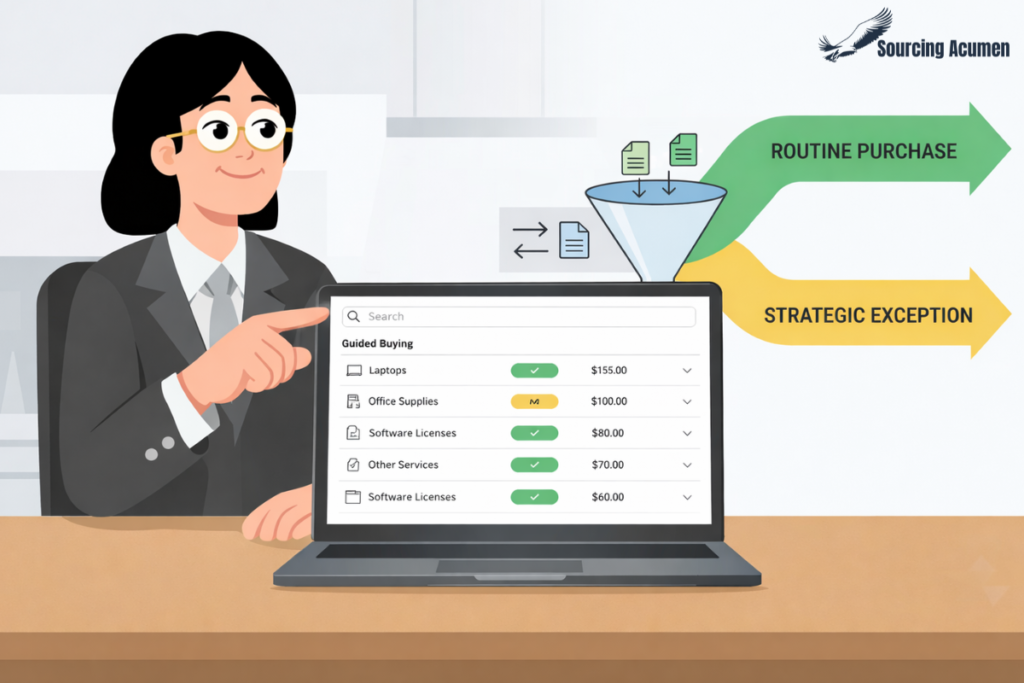
A well-designed guided buying approach helps the organization decide, early, which requests:
- Are genuinely routine
- Require light oversight
- Deserve deliberate attention
This happens before requests reach buyers or approvers – while context is still easy to capture and intent is still fresh.
The outcome is better-timed decisions.
IV. How Decision-Making Improves in Practice
When guided buying is embedded properly, daily work starts to feel different.
Buyers stop spending time sorting requests and start spending time evaluating them. Approvers see why something followed a particular path instead of guessing whether it should have.
Routine purchases move with less friction, not because they bypass governance, but because governance no longer treats them as suspicious by default.
More importantly, exceptions stand out. High-risk, ambiguous, or precedent-setting decisions receive attention precisely because they are no longer buried among routine work.
Judgment becomes intentional.
V. Organizational Implications
Over time, this shift changes how procurement is perceived:
- Requesters trust the process to move quickly when it should
- Procurement trusts that risk will surface early
- Leaders trust outcomes without micromanaging approvals
This is the difference between a process people tolerate and one they rely on.
Conclusion
Guided buying is not about control.
It is about creating an operating rhythm where routine work moves predictably, and judgment shows up where it matters.
Organizations that get this right do not eliminate governance.
They make it usable.
At its core, guided buying is a design choice:
Decide early what deserves attention and let everything else fall into place.
That is how speed and trust coexist in modern procurement.