Author: Glenn Gardner
Executive Summary: Every Sourcing Event is a Game
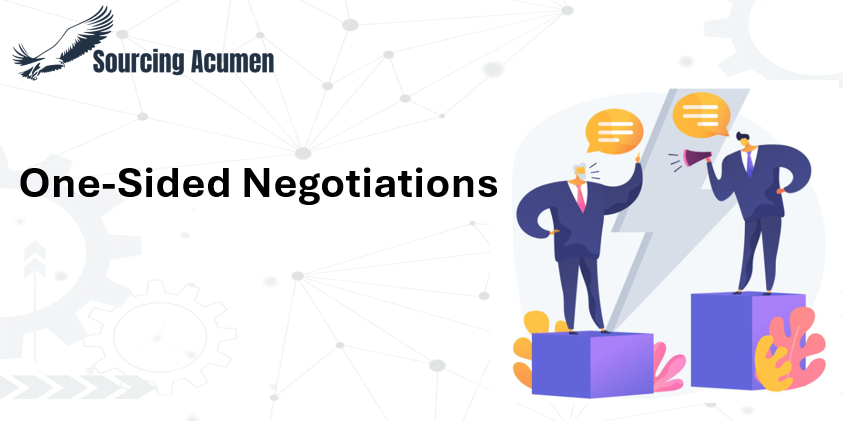
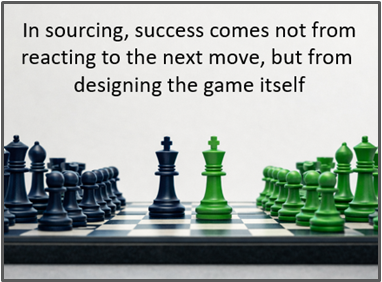
Game theory is defined as the mathematical modeling of strategic interaction among rational (and irrational) agents. In the context of procurement, every RFQ, auction, and negotiation is, by definition, a game. The players are the buyers and suppliers; the tactics are the bids and counteroffers; and the payoffs are the awarded contracts. Glenn Gardner, believes the most successful procurement leaders don’t just “play” the game – they architect it. By designing the rules of engagement, you can predict market reactions and drive superior economic results.
I. The Two Foundational Game Types
Sequential vs. Simultaneous Sourcing Games
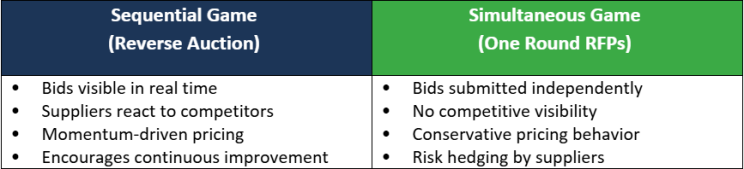
1. Sequential Games: Competing in the Open (Reverse Auctions)
In sequential games, players act with visibility into competitors’ moves.
Procurement reality: Reverse auctions and real-time bidding formats. Suppliers see where they stand and can react immediately.
What this drives:
- Continuous price pressure
- Tactical bidding behavior
- Clear signals about competitive intensity
Strategic risk:
Suppliers may stall when margins become thin, creating an artificial equilibrium. Without the right rules – bid decrements, extensions, or lot structures – competition can flatten prematurely.
Well-designed auction mechanics reintroduce momentum and force rational economic decisions until true market limits are reached.
2. Simultaneous Games: Competing Without Market Signals (One-Round RFPs)
In simultaneous games, participants make decisions without knowing how competitors will act.
Procurement reality: In many RFPs, suppliers submit pricing and proposals without visibility into where competitors are positioned, even though buyers can review all bids as they are received.
What this drives:
- Conservative pricing strategies
- Built-in risk buffers
- Greater reliance on assumptions about competitor behavior
Strategic risk:
When suppliers lack market signals, they often protect margins rather than compete aggressively. This is rational behavior – but it frequently results in higher pricing and less differentiation.
Without feedback mechanisms or multiple competitive rounds, these events can leave significant value unrealized.
II. Designing the Rules: The Power of Mechanism Design
In game theory, mechanism design means setting rules so that each participant’s rational choice also benefits the system owner – in this case, the buyer.
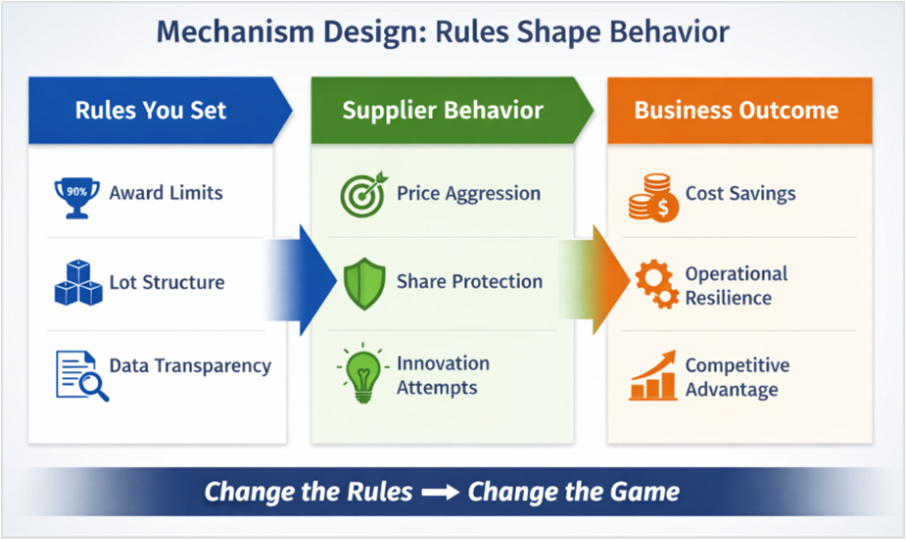
Examples of design choices that materially change outcomes:
Constraint-Based Awards
Rules such as:
- “No more than 90% awarded to one supplier.”
- “Minimum participation for new entrants”
- “Regional diversification requirements”
These create competitive sub-games where:
- Incumbents must defend share
- Challengers must bid aggressively to break in. Result: sustained pressure across the entire cost curve.
Information Symmetry
When incumbents have better operational knowledge than new suppliers, competition weakens.
Providing:
- Clean historical demand data
- Lane-level or SKU-level detail
- Transparent performance expectations
- Reduces risk premiums and increases true price competition
Fair information doesn’t protect suppliers – it intensifies competition.
III. The Zero-Sum Game: Vying for the “Pot”
In many sourcing events, there is a fixed “pot” or “award”. This is a Zero-Sum Game: for one supplier to gain more of the award, another must lose.
For these categories, we recommend sequential, feedback-driven formats where suppliers can see:
- Current award position
- Marginal cost to improve ranking
- Trade-offs between price and volume
This allows suppliers to calculate exactly how much they are willing to concede for additional share – pushing bids until they reach true economic breakpoints.
Buyers gain not only lower pricing, but clearer insight into supplier cost structures and competitiveness.
IV. Our Perspective: Begin with the End in Mind
As Glenn Gardner, notes: “If you aren’t willing to predict an event’s outcome before you start, you aren’t ready for the event.”
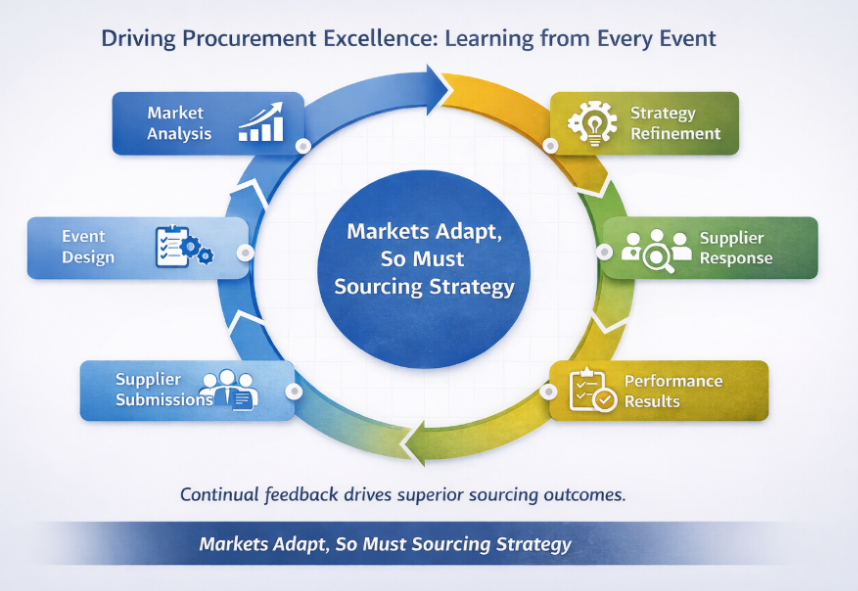
Sourcing excellence comes from understanding market psychology before publishing requirements.
Our 2026 Recommendations:
- Analyze the market type
- Use performance-based RFPs
- Document and learn from every sourcing event
Conclusion
In 2026, the best procurement organizations are Learning Organizations. By applying the principles of Game Theory, procurement leaders move beyond price-chasing and become architects of market value. This process helps to drive transparent decision-making.